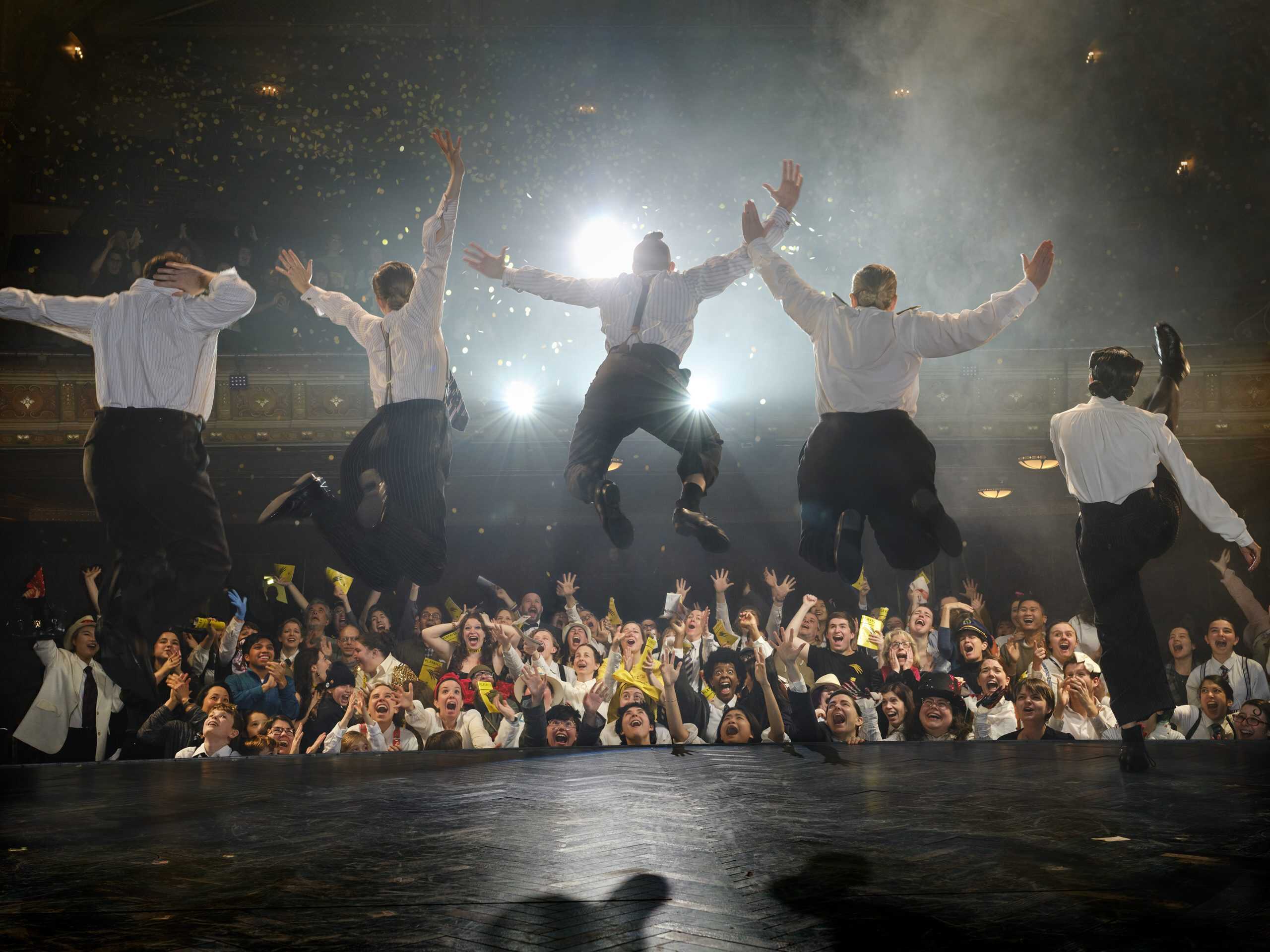
But the cast was so used to crazed fans by then that they couldn’t really help me either. Cumming generously offered the idea that watching people triumph over fascism night after night might be healing in light of the (ahem) current conditions of the world. Hodgson wondered if I, a writer, was vexed by the fact that I can’t seem to understand the organizing principles of what makes the show so much greater than the sum of its bonkers parts. Which is quite astute and fair! Because: Maybe! Likely even. But could that really be it? Professional jealousy? Competitiveness? Roberts said that a common theme she hears from Mincefluencers is how much fun it looks like they’re all having — have I even gone into that yet? — these college friends who wrote a thing in order to make one another laugh, how a person wants to feel like a part of that.
I don’t know, but while I was at work trying to track down a person whom the show’s press agent told me had seen it more than 200 times, I remembered something Hodgson told me early on, which is that every night, and twice on Wednesday and Sunday, they get to the part when Roberts (as Bevan) comes in and says that Hitler fell for the plan, that he’s moving his troops from Sicily to Sardinia. And every night in their performance are the vestiges of a horror-comedy troupe in fright wigs with a small cult following that cannot believe they are here on a Broadway stage. They had this idea, and they worked it out meticulously over thousands and thousands of hours, not one moment of the show untouched by their inspired energy. And now, every night, they deliver it to their audience for their joy and pleasure, uncorrupted by intermediaries. Every night, Hitler’s troops get diverted to Sardinia, and every night, they are there to tell you about it, how it all turned out right in the end. They’re nearly 1,000 performances in, and it’s all still there. Whether or not I find out what has me so consumed, it’s worth going to see just for that.
Thirty-three hours and 58 minutes is a lot of time to spend inside one theater, watching the same show again and again. I have been there to watch Cumming, who flourishes a leg from beneath a skirt in that secretary scene, go from having that leg naked to having a knee brace on it to, as of this writing, having his leg being at full strength again and brace-free. I have been there for a flubbed line. I have been there when, at one of Cumming’s understudy’s first performances, there was one adorable misstep that the cast lovingly corrected as the crowd cheered. I have been there when someone seated behind me thought that “Dear Bill,” the moving and heartbreaking song in which the show slows down and begins to reveal what its entire message has been this whole time, was hilarious.
I was once there when a full-grown woman who is my above-average height sat down right in front of me on a booster seat.
But mostly, when I’m there, I have time to think. I think about how I once defined myself by productivity, and in those moments, I am overcome with self-loathing. Sometimes I have the strange dysphoria of the repeat theater customer and am embarrassed not just for myself but also for everyone onstage, acting at the beginning of the show as if we don’t know what’s going to happen by the end. (On the nights I am embarrassed, I am mostly embarrassed for myself.)
But immediately, the embarrassment makes way for shame, when I realize that they are at their job and I am just enacting insane behavior, but as soon as that shame begins to rise, so does my defiance. Why shouldn’t I be here? Why shouldn’t I indulge in the things that I love when there are so few of them? Because outside that theater, there is a flatness — an anhedonic quality that, yes, is associated with aging and maybe even with depression too, but it’s also associated with the state of the culture these days, a new culture that asks nothing of us but instead meets us where we are, which is on our phones and not interested in surprise or new emotion. The movies are one iteration after another of a thing I saw last year. On TV, it is all one boring true-crime blob of pessimism and jump-scares and banal thrills to keep a person clicking to the next episode of something because of one cheap cliffhanger after another.
I leave the Golden Theater, and around me there is nothing but stagnation, but dearth, but a corporation’s version of creativity. We consume the same story over and over, acted out by the same five or six popular, high-performing actors who look exactly the same as they did in the last thing they were in, all of it seemingly designed to remind you of something you already liked, which I guess is good business, an algorithm daring you to do nothing but have a repeat benign experience. The audience’s sophistication has peaked at the exact time that an algorithmic “mid” culture rose up and asked what is the least amount of work it could do to keep a person rolling through its offerings. I leave room for falling into the cliché of every person who ever turned 50 and wrote an essay about how terrible the culture has become, but that doesn’t diminish where I am, which is that I’m so bored I want to die.
Every now and again, there is a tiny bud that finds its way to the surface through the deep freeze of this relentless winter, this desert drought of originality and ideas. The dancing scene in “Sinners.” “Fleabag” and “Tár.” The limited series “The Curse.” “MARTY SUPREME”!!!
The Alex Katz exhibition at the Guggenheim (and the Alice Neel exhibition at the Met, while we’re at it). “Prince Faggot” by Jordan Tannahill and “The Comeuppance” by Branden Jacobs-Jenkins and sure, I’ll say the obvious, “Hamilton.” The antisemitism episode of “The Rehearsal.” The bridge of Taylor Swift’s “Would’ve, Could’ve, Should’ve” and the line about monsters being just trees in “Out of the Woods” and all of the 10-minute “All Too Well.” “Grand Theft Hamlet.” The dance scene in “John Proctor Is the Villain.” “The Favourite.” The twist at the end of “Nickel Boys,” where the form of that novel overtakes its function perfectly. These things leave me in awe, not just of their creation but of creation itself.
That last line is a lyric from “Operation Mincemeat.”
Disclosure: I didn’t need to go again to the Halloween show for this story, but I did.
“Operation Mincemeat” takes its place beside all of them, uncategorizable in its utter freedom. It’s hard to find anything these days that has its farm-to-table arc of analog success. A group of college friends making shows; then having an idea to make a musical; then looking for a story as opposed to having it presented to you after it was formulated in a lab of entertainment executives; then workshopping it and becoming singularly determined to get it exactly, specifically right; then taking it from a small theater to a large one. Add to that its consideration to stay ahead of its audience, the energy and the care to do something crazy (a midscene flashback, a running joke about Cockneys that makes no sense but is even funnier every time, a totally deranged finale, Nazis in a boy band; you really do have to see it) — all just to amuse you, so that you are breathless to keep up and delighted and flattered to be reminded that you were worth the attention.
And this, perhaps, is the closest I’ve come to understanding this vexation. The tension I hold isn’t between my professionalism and the joys of fandom; it’s between the deadness of the culture and the surprise and joy of genuine originality. There is still a vestige of my brain that is fighting to save me, to defeat the doldrums of passive consumption by dragging me to fight for active passion. I can defeat those doldrums: Any day but Monday, I can stand right up from my desk and walk right over a few blocks and sit right down in a single seat and stare at the theater’s cadmium yellow curtain, trying not to face down the ridiculous crisis I have found myself in — which is that when I’m in this theater, I am happy and engaged, and when I’m not, I feel that I am useless and living in a world that seems intent on smothering the light that keeps out the dark.